By GEARITUP.ai Editorial Team * Last Updated: May 2026
This post contains affiliate links; we may earn a small commission, at no additional cost to you.
Overview
These are the two biggest names in CRM — and for good reason. Between them, HubSpot and Salesforce account for a huge chunk of the global CRM market. But they are not competing for the same customer. One is built for speed and simplicity. The other is built for depth and power. Buying the wrong one is one of the most common and expensive tech mistakes a growing business can make.
Here is what you actually need to know before you decide.
What Each Platform Is Actually Built For
HubSpot is an all-in-one CRM platform built around ease of use and time-to-value. Its Sales Hub, Marketing Hub, Service Hub, Content Hub, and Operations Hub all share a single unified database — meaning your marketing, sales, and support teams are always looking at the same customer record. The free plan is genuinely functional, not a stripped-down teaser, and the Breeze AI layer is included across all paid plans at no extra charge. HubSpot is built for teams who want to be up and running in days, not months.
Salesforce is a modular enterprise ecosystem — the world’s largest CRM platform with approximately 20.7% global market share. You buy separate clouds (Sales Cloud, Service Cloud, Marketing Cloud) and integrate them. The depth of customization is unmatched: developers can build virtually any business process on the Lightning Platform, and the AppExchange marketplace has thousands of extensions. The tradeoff is complexity, cost, and implementation time. Salesforce is built for organizations with dedicated admins and complex sales operations.
The most expensive mistake in CRM is choosing Salesforce when HubSpot would have done the job — or choosing HubSpot and outgrowing it in 18 months.
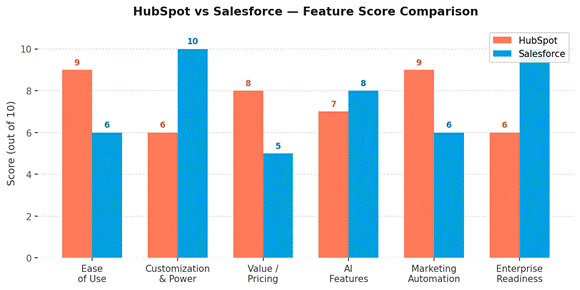
Feature Score Comparison
Scores are research-based ratings drawn from G2 data (127,000+ reviews), Gartner, Capterra, and analyst reports. They reflect consensus user experience across the market — not a single evaluation.
| Category | HubSpot | Salesforce | Winner | Research Score |
| Ease of Use | 9 / 10 | 6 / 10 | HubSpot | ★ Research-based |
| Customization & Power | 6 / 10 | 10 / 10 | Salesforce | ★ Research-based |
| Value / Pricing | 8 / 10 | 5 / 10 | HubSpot | ★ Research-based |
| AI Features | 7 / 10 | 8 / 10 | Salesforce | ★ Research-based |
| Marketing Automation | 9 / 10 | 6 / 10 | HubSpot | ★ Research-based |
| Enterprise Readiness | 6 / 10 | 10 / 10 | Salesforce | ★ Research-based |
Pros & Cons at a Glance
| ✅ HubSpot Pros | ❌ HubSpot Cons | ✅ Salesforce Pros | ❌ Salesforce Cons |
| Generous free plan (genuinely usable) | Gets expensive fast at Professional tier | Unmatched customization & extensibility | Steep learning curve — needs dedicated admin |
| Fastest time-to-value of any major CRM | Less customizable for complex workflows | Dominant enterprise ecosystem (AppExchange) | True cost is 3–4x the list price at scale |
| All hubs share one unified database | API rate limits can bottleneck integrations | Agentforce AI is the most powerful in class | Long implementation timelines (2–8 months) |
| Breeze AI included at no extra cost | Weaker for large enterprise deployments | Best sales forecasting & territory tools | AI (Agentforce) costs $50–$125/user/month extra |
| Best-in-class email & marketing automation | Advanced reporting needs higher tiers | Industry-specific vertical clouds | Marketing Cloud is a separate product entirely |
| Transparent, predictable pricing | Can outgrow for complex B2B sales ops | Scales to virtually any business complexity | Overkill and expensive for SMBs |
Feature Breakdown
Ease of Use
This is where HubSpot wins cleanly and without argument. G2 gives HubSpot an ease-of-use score of 8.7 versus Salesforce’s 8.0 — and the gap feels wider in practice. Most HubSpot users are managing their own pipelines within the first week. Salesforce requires configuration, training, and in most cases a dedicated Salesforce administrator just to keep the system healthy. The average Salesforce implementation runs 2–8 months. HubSpot typically runs 2–4 weeks.
Winner: HubSpot — not close.
Customization & Power
Salesforce wins this category just as cleanly. The platform can model virtually any sales process, support any business complexity, and extend into industry-specific territory through vertical clouds for financial services, healthcare, manufacturing, and more. Its AppExchange has thousands of integrations. HubSpot is customizable within its guardrails — which keeps things manageable but limits what complex enterprise operations can do. If your sales process is non-standard or highly regulated, HubSpot will eventually frustrate you.
Winner: Salesforce — unambiguously.
Value / Pricing
HubSpot wins on pricing for the vast majority of businesses. Its Starter tier dropped to $15/seat/month in early 2026, making it one of the most affordable entry points in the category. Its free CRM is genuinely functional — not a trial. Salesforce raised Enterprise tier pricing by 6% in August 2025 (now approximately $165/user/month) and its Agentforce AI costs an additional $50–$125/user/month on top. For a 50-user team over three years, research puts Salesforce’s total cost at 3.4x HubSpot’s at comparable tiers once implementation, admin, and add-ons are factored in.
Winner: HubSpot — significantly.
AI Features
Both platforms have made serious AI investments in 2026, but with different strategies. HubSpot’s Breeze AI is simpler, built into all paid plans, and delivers immediate practical value for lead scoring, email optimization, content generation, and workflow suggestions — no extra cost, no setup. Salesforce’s Agentforce is more powerful: capable of resolving 66% of service inquiries autonomously and handling 6,000+ simultaneous interactions. But it requires Enterprise+ tiers, technical setup, and a separate line item of $50–$125/user/month. If autonomous AI agents are central to your strategy, Salesforce justifies the premium. For most teams, Breeze AI is plenty.
Winner: Salesforce for enterprise AI. HubSpot for included, practical AI.
Marketing Automation
HubSpot owns this category. It was built around inbound marketing and that heritage shows — email automation, lead nurturing sequences, attribution reporting, and campaign analytics are class-leading and deeply integrated with the sales side. Salesforce’s marketing tools live in a completely separate product (Marketing Cloud) that requires its own subscription, implementation, and integration work. For teams where marketing and sales need to share data seamlessly, HubSpot’s unified platform is a meaningful operational advantage.
Winner: HubSpot — clearly.
Enterprise Readiness
Salesforce is the category leader for enterprise deployments and has been for two decades. Its security model, compliance certifications, audit trails, territory management, and advanced forecasting tools are purpose-built for large, complex organizations. It holds approximately 20.7% of the global CRM market — more than its four nearest competitors combined. HubSpot has made meaningful progress at the enterprise tier, but users at large organizations consistently report hitting its ceiling in reporting depth, customization, and governance controls.
Winner: Salesforce — clearly.
Pricing Breakdown
| Plan | HubSpot | Salesforce | Better Value |
| Free Plan | Free CRM (genuinely full-featured) | No free plan — 30-day trial only | HubSpot |
| Entry Paid | $15/seat/mo (Starter, early 2026) | $25/user/mo (Starter Suite) | HubSpot |
| Professional | $90/seat/mo (Sales Hub Pro) | $80/user/mo (Sales Cloud Pro) | Salesforce |
| Enterprise | $150/seat/mo (Sales Hub Ent.) | $165/user/mo (Enterprise, post Aug 2025 increase) | HubSpot |
| Unlimited | N/A | $330/user/mo (Unlimited+) | HubSpot |
| AI Add-on | Breeze AI included in all plans | Agentforce: +$50–$125/user/mo | HubSpot |
| Implementation | Weeks — low admin overhead | 2–8 months — needs dedicated admin | HubSpot |
Important: list prices are misleading. For Salesforce, factor in implementation partner fees, a dedicated admin salary ($80,000–$120,000/year for a Salesforce admin), and AI add-on costs. For HubSpot, watch for per-seat pricing at Professional and Enterprise tiers and add-ons like dedicated IP and transactional emails.
What Real Users Are Saying
HubSpot — G2 & Capterra
“HubSpot’s user interface is more straightforward, which is particularly beneficial for small businesses with limited technical resources. The ease of use score of 8.7 versus Salesforce’s 8.0 reflects a real day-to-day difference.”
— G2 platform comparison data, 2026
“The free CRM stays free forever and includes contacts, deals, tasks, and pipelines. Paid hubs unlock advanced automation, marketing tools, and analytics. It evolves smoothly from a free CRM to a comprehensive multi-hub platform.”
— G2 reviewer summary, HubSpot CRM
Salesforce — G2 & Capterra
“The best thing about Salesforce Sales Cloud as a salesperson is the ability to neatly and conveniently organize my book of business for success and growth. The advanced search, filtering, and customization options are unmatched.”
— Verified G2 reviewer, Senior Sales Rep, Health & Wellness, Feb 2026
“Salesforce Sales Cloud is a premier solution for any organization looking to scale, offering a UI that is both sleek and highly functional once tailored to your specific needs — but that tailoring takes real time and real expertise.”
— Verified Capterra reviewer, Telecommunications, April 2026
Reddit’s Take
“Your CRM decision shouldn’t feel like picking which headache you can tolerate. HubSpot promises simplicity, then locks essential features behind expensive tiers. Salesforce gives you endless power if you can afford the army of consultants needed to make it work.”
— Reddit user, r/CRM
Who Should Choose Which
Go with HubSpot if…
- You are a startup, SMB, or mid-market team under ~200 employees
- Marketing and sales alignment matters — you want one platform, one database
- You want to be live within weeks, not months
- Budget is a real constraint and you need to start free or close to it
- Email marketing, lead nurturing, and inbound are core to your go-to-market
- You do not have — and cannot afford — a dedicated CRM administrator
Go with Salesforce if…
- You are a large enterprise or mid-market company with complex sales operations
- Your business process is non-standard and requires deep customization
- You need industry-specific compliance or vertical cloud features (healthcare, financial services, manufacturing)
- Autonomous AI agents and advanced forecasting are core to your sales strategy
- You have (or can hire) a dedicated Salesforce administrator
- You are running ERP integration or managing a massive contact database at scale
Go with neither if…
- You are a solo founder or very early-stage startup — a spreadsheet or Notion database is free and will serve you fine until you have a real sales motion worth systematizing.
Final Verdict
HubSpot is the right CRM for most businesses. Salesforce is the right CRM for the ones that genuinely need what only Salesforce can deliver.
If you are under 200 employees, need marketing and sales in one place, and want a system your team will actually adopt and use — HubSpot wins on almost every dimension that matters: price, ease of use, time-to-value, and included AI. The free plan alone removes all the risk from evaluating it.
If you are running a large enterprise with complex, non-standard sales operations, industry-specific compliance requirements, or a genuine need for autonomous AI agents at scale — Salesforce justifies its premium and complexity. The depth, ecosystem, and extensibility are genuinely unmatched. Just go in with eyes open on the total cost.
The most common expensive mistake? Choosing Salesforce because it sounds more serious, only to spend six months and $50,000 implementing a system your team of 30 never fully adopts. HubSpot’s free tier costs nothing to try. Start there, grow into it, and only cross to Salesforce when you have a specific reason — not just ambition.
Research note: Scores and analysis are based on published feature documentation, G2 user reviews (127,000+), Gartner Peer Insights, Capterra, TrustRadius, IDC CRM market share data, and independent analyst comparisons. Pricing verified May 2026 from official sources. This post may contain affiliate links.
Next Steps to Gear It Up!
If you’re serious about building your business online, with Content, Leads and Payment collection, these 3 tools matter most. Here’s how to choose the Best Ones…