By GEARITUP.ai Editorial Team * Last Updated: May 2026
This post contains affiliate links; we may earn a small commission, at no additional cost to you.


Overview
If you have ever sent a marketing email, you have probably considered Mailchimp. It has been the default starting point for small business email marketing since 2001 — and for a long time, that reputation was well earned. But 2026 Mailchimp is a different product to the one that built that reputation. Its free plan has been gutted, automation is paywalled, and the AI features that were once a selling point have been quietly demoted following Intuit’s $12 billion acquisition.
ActiveCampaign sits at the other end of the spectrum. It is the platform serious marketers graduate to when Mailchimp stops being enough — and in 2026, with the launch of Active Intelligence AI, it has made that case more compelling than ever.
The right choice comes down to where you are in your email marketing journey. Here is the honest breakdown.
What Each Platform Is Actually Built For
Mailchimp is an all-in-one small business marketing platform built around simplicity and speed. Email campaigns, basic automations, landing pages, social posting, and Google ad management all live under one roof. Its drag-and-drop editor and 100+ templates make it the easiest platform in the category to pick up and use on day one. It now serves over 11 million users globally. The tradeoff is that the free plan has been progressively stripped back, automation depth is limited, and deliverability benchmarks trail the specialist platforms.
ActiveCampaign is an autonomous marketing platform built around advanced automation, a built-in CRM, and — as of 2026 — the most genuinely capable AI layer in the email marketing category. Its visual automation builder supports 135+ triggers, conditional branching, multi-channel sequences (email, SMS, WhatsApp, and site messaging), and split-path testing. The Active Intelligence suite gets smarter the longer you use it, building a persistent model of your brand voice and engagement patterns. It is not the easiest tool to start with — but it is the tool most growing businesses wish they had started with.
The clearest way to frame it: Mailchimp is where most people start email marketing. ActiveCampaign is where they end up when they get serious about it.
Feature Score Comparison
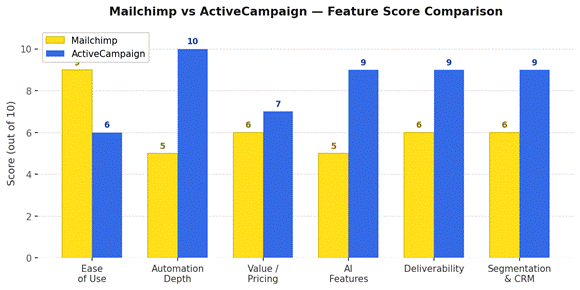
Scores are research-based ratings drawn from G2, Capterra, independent deliverability benchmarks, and analyst comparisons. They represent consensus user experience across the market — not a single data point.
| Category | Mailchimp | ActiveCampaign | Winner | Research Score |
| Ease of Use | 9 / 10 | 6 / 10 | Mailchimp | ★ Research-based |
| Automation Depth | 5 / 10 | 10 / 10 | ActiveCampaign | ★ Research-based |
| Value / Pricing | 6 / 10 | 7 / 10 | ActiveCampaign | ★ Research-based |
| AI Features | 5 / 10 | 9 / 10 | ActiveCampaign | ★ Research-based |
| Deliverability | 6 / 10 | 9 / 10 | ActiveCampaign | ★ Research-based |
| Segmentation & CRM | 6 / 10 | 9 / 10 | ActiveCampaign | ★ Research-based |
Pros & Cons at a Glance
| ✅ Mailchimp Pros | ❌ Mailchimp Cons | ✅ ActiveCampaign Pros | ❌ ActiveCampaign Cons |
| Easiest email tool to learn — up in minutes | Free plan gutted in Jan 2026 (250 contacts, 500 sends/mo) | Best-in-class automation — 135+ triggers, visual builder | No free plan — 14-day trial only |
| Free plan (limited but functional for tiny lists) | Automation tops out at basic if/else logic only | Active Intelligence AI — genuinely learns & improves | Steeper learning curve — not beginner-friendly |
| 800+ native integrations (largest ecosystem) | Charges for duplicate contacts across audiences | 94%+ deliverability — among the highest in the category | Pricing scales with contacts — gets expensive at volume |
| Best template library (100+ polished designs) | Deliverability 85–88% — lowest in this comparison | Built-in CRM — no separate tool needed for most teams | Feature depth can overwhelm simple use cases |
| Built-in social posting & Google ad tools | AI features largely demoted post-Intuit acquisition | 1,000+ integrations including Salesforce, Shopify, Zendesk | Email design builder less polished than Mailchimp |
| Familiar brand — widely supported by contractors | Pricing scales steeply — 50K list costs ~$310/mo | 30% higher click rates than Mailchimp (independent benchmarks) | Deliverability consultations cost extra ($79/session) |
Feature Breakdown
Ease of Use
Mailchimp wins this category clearly. Its drag-and-drop editor, intuitive navigation, and guided onboarding make it the fastest platform in the category to go from sign-up to first campaign sent. G2 and Capterra reviewers consistently rate it 4.3–4.5 stars for usability. Most users can get a professional-looking campaign live within an hour of creating an account — no training required.
ActiveCampaign has a steeper learning curve. The automation builder is powerful, but power requires configuration. New users commonly report spending a few days getting familiar with the interface before feeling confident. The 2026 platform updates have improved discoverability significantly, and the AI Campaign Builder now generates complete workflows from plain-language descriptions — reducing the setup burden considerably. But it is still not a beginner tool.
Winner: Mailchimp — no contest for first-timers and simple campaigns.
Automation Depth
This is where ActiveCampaign wins by the widest margin of any category in this comparison. Its visual automation builder supports 135+ triggers, conditional branching logic, goal tracking, split-path testing, and multi-channel sequences that combine email, SMS, WhatsApp, and on-site messaging in a single workflow. The Automation Map gives a bird’s-eye view of every active journey and how they interconnect. There are 900+ pre-built automation recipes. Independent reviewers consistently call it the most powerful automation system at SMB pricing.
Mailchimp’s “Customer Journeys” builder handles basic sequences — welcome emails, birthday discounts, abandoned cart reminders — with simple if/else branching. That covers the majority of what most small businesses actually need. But once you want multi-step behavioral journeys tied to CRM data, lead scoring, or multi-channel orchestration, Mailchimp’s automation tops out quickly.
Winner: ActiveCampaign — the single biggest capability gap between these two platforms.
Value / Pricing
This one requires nuance. Mailchimp appears cheaper at first glance — entry paid starts at $13/month — but its pricing model charges per subscriber and counts duplicate contacts across audiences separately. A 50,000-contact list on Mailchimp’s Standard plan runs approximately $310/month. The free plan, once a genuine asset, was reduced in January 2026 to just 250 contacts and 500 emails per month with automations removed entirely.
ActiveCampaign has no free plan, only a 14-day trial. But its pricing scales more predictably, the contact counting methodology is cleaner, and — critically — it includes a full built-in CRM that most Mailchimp users end up paying separately for. For businesses with lists over 5,000 contacts, ActiveCampaign frequently comes out cheaper when total stack costs are factored in.
Winner: ActiveCampaign at scale. Mailchimp for tiny lists who just need to get started.
AI Features
In 2026 this is not a close contest. ActiveCampaign’s Active Intelligence suite operates differently from most AI marketing features: it builds a persistent model of your brand voice, engagement patterns, and performance history over time — it genuinely gets smarter the longer you use it. The AI Campaign Builder generates complete multi-step workflows from plain-language descriptions. Predictive Sending optimizes delivery timing per individual contact, producing a documented 17% improvement in click-through rates. AI-discovered segments surface audiences marketers would miss manually.
Mailchimp’s AI story has gone in the opposite direction. Since Intuit’s acquisition, the AI design features — once a genuine differentiator — have largely been demoted or quietly retired according to Zapier’s 2026 analysis. “Intuit Assist” provides guided, manual creation support rather than autonomous optimization. It is a useful aid; it is not a competitive AI layer.
Winner: ActiveCampaign — Active Intelligence is the most capable AI implementation in the email category in 2026.
Deliverability
Deliverability is the unsexy metric that determines whether your emails actually reach the inbox — and this is where Mailchimp’s reputation has quietly eroded. Independent benchmarks consistently put Mailchimp at 85–88% inbox placement. ActiveCampaign achieves 94%+ inbox placement and 30% higher average click rates across campaigns with 1,000+ recipients, according to 2026 independent benchmark data.
ActiveCampaign’s deliverability infrastructure includes native domain verification tools (SPF, DKIM, DMARC), automated bounce management, automated list hygiene workflows, and dedicated IP options for high-volume senders. Mailchimp offers similar authentication tools but the shared sending infrastructure on lower tiers and its historical reputation as an easy-access platform has meant its deliverability benchmarks trail specialist platforms.
Winner: ActiveCampaign — 94%+ vs 85–88% is a material difference that compounds with every campaign you send.
Segmentation & CRM
ActiveCampaign wins here too, and by a significant margin. Its lead scoring system lets you add or subtract points from a contact’s profile based on granular behavioral criteria — not just open rates, but site visits, product purchases, customer lifetime value, geographic location, and dozens of other signals. The built-in CRM creates a unified marketing-and-sales record that eliminates the need for a separate CRM tool for most teams. Chrome and Outlook extensions bring CRM context directly into your inbox.
Mailchimp’s segmentation is functional for basic use cases. Its five-star engagement rating system provides a broad sense of subscriber quality. For businesses that need simple audience splits based on open rates or purchase history, Mailchimp covers the bases. For businesses running sophisticated lead nurturing and multi-stage customer journeys tied to sales pipeline data, it runs out of depth quickly.
Winner: ActiveCampaign — not close for any business running a real sales-marketing motion.
Pricing Breakdown
| Plan / Feature | Mailchimp | ActiveCampaign | Better Value |
| Free Plan | 250 contacts, 500 sends/mo (gutted Jan 2026) | 14-day trial only — no free plan | Mailchimp (barely) |
| Entry Paid | $13/mo — Essentials (500 contacts) | $15/mo — Starter (1,000 contacts) | ActiveCampaign |
| Mid Tier | $20/mo — Standard (500 contacts) | $49/mo — Plus (1,000 contacts) | Mailchimp |
| Professional | $350/mo — Premium (500 contacts) | $79/mo — Professional (1,000 contacts) | ActiveCampaign |
| Large List (50K) | ~$310/mo Standard tier | ~$279/mo Plus tier | ActiveCampaign |
| Pricing Model | Per subscriber (charges duplicates) | Per contact (cleaner counting) | ActiveCampaign |
| CRM Included | Basic audience management only | Full built-in CRM with lead scoring | ActiveCampaign |
| Deliverability | 85–88% inbox placement | 94%+ inbox placement | ActiveCampaign |
Critical watch-out for Mailchimp: the platform charges for unsubscribed and duplicate contacts across audiences, which inflates the effective contact count and therefore the price. Always calculate your cost based on your actual sendable list size, not your raw contact count. At 50,000 contacts, ActiveCampaign’s Plus plan ($279/month) undercuts Mailchimp’s Standard plan ($310/month) — and includes a full CRM.
What Real Users Are Saying
Mailchimp — G2 & Capterra
“Mailchimp is a solid email marketing tool with an intuitive interface and a wide range of templates that make it easy to get started quickly. The segmentation and automation features cover the basics well. The general consensus is that it feels adequate — but outdated compared to newer platforms.”
— ActiveCampaign platform analysis citing G2 consensus, 2026
“Mailchimp is easy to master, with lots of guided help for crucial features. Setting up your account requires only a few clicks, so you can finish everything in minutes. It is the right tool if you just need to get going quickly without a learning curve.”
— Moosend platform review citing G2 user feedback, 2026
ActiveCampaign — G2 & Independent Reviewers
“I’ve tested every major competitor, and nothing comes close to ActiveCampaign’s visual workflow editor for building complex, multi-step sequences. You get 135+ automation triggers, you can split-test entire automation paths — and as of 2026 you can let AI do all the grunt work that once took literally days.”
— VentureHarbour email marketing expert, April 2026
“ActiveCampaign dominates in advanced automation, CRM integration, and deliverability — achieving 94%+ inbox placement with 30% higher click rates. It is the clear winner for scaling businesses with complex marketing needs.”
— Independent analysis, Hamsterstack, March 2026
Reddit’s Perspective
“If you are serious about marketing automation, you will outgrow Mailchimp. It is where you start, not where you finish. ActiveCampaign is genuinely powerful — but plan for a learning curve before you see the payoff.”
— Reddit user, r/emailmarketing
Who Should Choose Which
Go with Mailchimp if…
- You are brand new to email marketing and need to get a campaign out this week
- Your list is under 1,000 contacts and your automation needs are simple (welcome email, basic drip)
- You need social media posting, Google Ads management, and surveys in the same tool
- You are a freelancer or solo operator who values the widest contractor/integration support
- Budget is very tight and even a $15/month starting price is a stretch
- You need the most polished email template library out of the box
Go with ActiveCampaign if…
- You are ready to invest in email marketing as a genuine growth channel, not just a newsletter tool
- You need multi-step behavioral automation tied to CRM data and lead scoring
- Deliverability matters — your business depends on emails actually reaching the inbox
- You want AI that genuinely learns your audience and improves performance over time
- You are selling products or services with a multi-step consideration journey
- You want a built-in CRM so you are not paying for both Mailchimp and a separate CRM tool
Go with neither if…
- You are a newsletter creator focused on audience monetization — Kit (formerly ConvertKit) is purpose-built for your use case and has a more generous free tier. If you are running an ecommerce store, Klaviyo’s Shopify-native automation is worth the premium.
Final Verdict
Mailchimp is the right starting point. ActiveCampaign is the right long-term platform for most businesses serious about email marketing.
If you are sending your first campaign, have a list under 1,000 people, and need something running by tomorrow — start with Mailchimp. The ease of use is genuine and the free tier, even gutted, is enough to validate whether email works for your audience before spending money.
If you have been doing email marketing for more than six months and feel like you are leaving performance on the table — better segmentation, smarter automation, campaigns that reach more inboxes — ActiveCampaign is the upgrade that most marketers eventually make. The 94%+ deliverability rate, the Active Intelligence AI that improves over time, and the built-in CRM that removes a tool from your stack all compound in value the longer you use the platform.
The data point that says it all: independent reports indicate that over 100 businesses per month migrate from Mailchimp to ActiveCampaign — and 95% of them cite deliverability as the primary driver. If your emails are not reaching inboxes, it does not matter how good the campaign is.

Research note: Scores and analysis based on G2 user reviews, Capterra, independent deliverability benchmarks, Reddit community feedback, and published pricing from official sources. Deliverability figures sourced from independent benchmark studies (March 2026). Pricing verified May 2026. This post may contain affiliate links.
Next Steps to Gear It Up!
If you’re serious about building your business online, with Content, Leads and Payment collection, these 3 tools matter most. Here’s how to choose the Best Ones…